
If there’s an orange or red notice zip-tied to your fence right now, you don’t need a definition of what a Stop-Work Order is. You need to know what happens next. So we’ll get the legal background out of the way quickly, then spend most of this guide on the part that actually matters: what Toronto Building expects from you, how long this realistically takes, and where people get stuck.
One thing worth saying up front, because it changes how you should feel about the next few weeks: a Stop-Work Order is not a punishment. It’s a pause button. Toronto Building uses it to freeze a situation until someone can confirm the work is safe and legal, not to end your project. Most orders get resolved. The ones that turn into real headaches are almost always cases where the owner either ignored the order or tried to talk their way around it instead of working through the process.
What a Stop-Work Order Actually Is
Under the Building Code Act, 1992 (the provincial statute that governs all of this, which Toronto Building enforces locally), a Stop-Work Order is issued under subsection 14(1). It tells you to immediately cease construction or demolition on whatever is described in the order, with one exception: you can still do the work needed to correct the violation itself.
A detail almost nobody mentions, but that matters for how seriously you should take the notice: only the Chief Building Official (CBO) can issue a Stop-Work Order. A regular building inspector can issue other kinds of orders, but a Stop-Work Order specifically has to come from the CBO or their delegate. That’s part of why it carries more weight than a routine inspection note: someone at a senior level has already decided the situation warrants it.
Two other legal points that are easy to miss but genuinely useful to know:
- It’s an offence to remove, cover, or obscure a posted order unless an inspector or Registered Code Agency authorizes it (BCA s.20). Don’t take the notice down, even if you’ve fixed the problem. Wait for it to be formally rescinded.
- The order can list companion orders alongside it. An Order to Comply, an Order Not to Cover or Enclose, or an Order to Uncover may all be referenced on the same notice, each pointing at a different piece of the problem.
Stop-Work Order vs. Order to Comply: They’re Not the Same Thing
This is where a lot of online guides on this topic get sloppy, and it’s worth being precise about, because the two orders create different obligations.
An Order to Comply is the more common first step. It tells you what’s wrong and gives you a deadline to fix it: submit missing drawings, obtain a permit, correct deficient work, whatever applies. Work doesn’t necessarily have to stop; you’re just on the clock.
A Stop-Work Order goes further: all covered work has to stop now, with no grace period to finish what you’re mid-task on. In practice, it’s common for both to land together, or for a Stop-Work Order to follow within a day or two of an ignored Order to Comply. If a property owner keeps building after an Order to Comply, the CBO doesn’t have to wait around. Escalating straight to a Stop-Work Order (and, in serious or repeat cases, a charge) is exactly the tool the Act gives them for that situation.
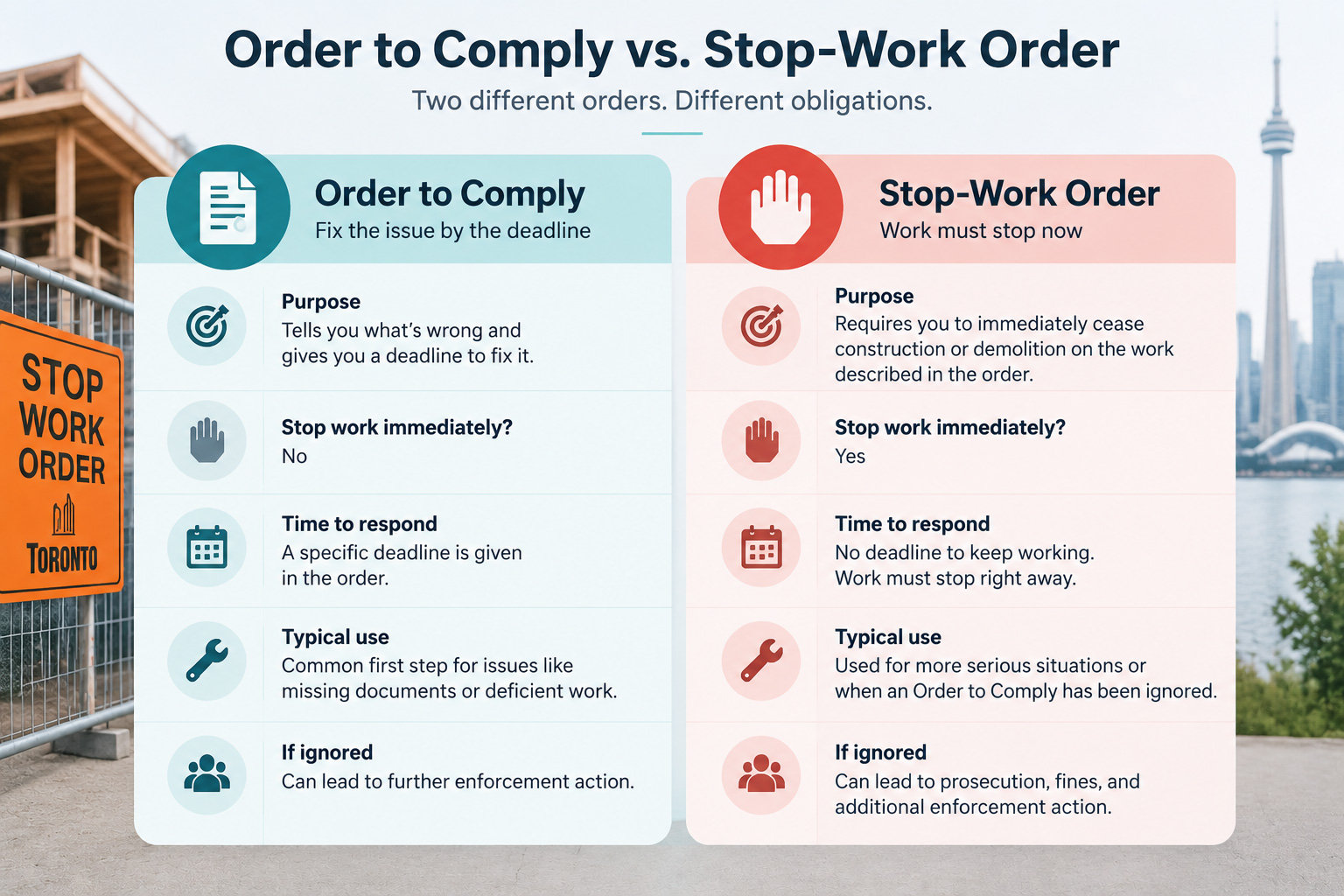
If your notice only references an Order to Comply, you likely have more flexibility on timing than someone holding an actual Stop-Work Order. Read the specific document you were handed. Don’t assume based on what a neighbour or contractor told you happened to them.
Why Toronto Building Issues Them
The reasons cluster into a handful of recurring patterns:
Construction without a permit. Basement apartments, structural wall removals, additions, and garden suites are the ones we see most often, usually because a homeowner was told (sometimes by a contractor who should have known better) that the work “didn’t need a permit.” Under s.8(1) of the BCA, most structural, plumbing, and occupancy changes do. Ontario’s permit requirement doesn’t have a statute of limitations, either: work done without a permit five years ago is still exposed today if it surfaces during a sale, refinance, or insurance claim.
Work that’s drifted from the approved drawings. You pulled a permit, but what’s actually on site doesn’t match what was approved: a wall moved, a window added, a load path changed. This is one of the more fixable categories, since the fix is usually a permit revision rather than tearing anything out.
Missed or skipped inspections. Toronto Building requires inspections at defined stages (footings, framing, insulation, plumbing rough-in, and so on). Covering up work before the required inspection happens, closing a wall before the framing inspection, for instance, is one of the fastest ways to trigger an Order Not to Cover or Enclose, followed by a demand to open it back up.
Safety and structural concerns. Anything flagged as an immediate life-safety issue, such as exposed wiring, an unsupported structural element, or an unstable excavation, moves faster through the system and is far less negotiable on timeline.
For scale: even large, well-resourced developers aren’t immune to this. Toronto’s Stop-Work Orders have made headlines before. The developer behind “The One,” the planned 85-storey tower at Yonge and Bloor, had construction frozen by the city over permit issues in 2020. If a project with that much professional oversight can get caught by the permit process, it’s worth taking seriously regardless of how small your renovation is.
What Should You Do Immediately After Receiving the Order?
Before the step-by-step resolution process below, three things need to happen in the first day or two:
Stop the named work, and nothing else. Not “finish this one section first.” The order applies the moment it’s posted, not once it’s convenient.
Read the order and identify the actual reason. It’ll fall into one of the patterns above: no permit, drawings that don’t match site conditions, a missed inspection, or a safety concern. Which one it is changes everything about what comes next, so don’t skip this and jump straight to “how do I get this lifted.”
Call the officer named on the order, or bring in a permit professional. The person who issued it is your fastest, most reliable source on what specifically needs to happen, faster than a forum post or a generic guide (including this one). If the situation involves as-built drawings, a permit revision, or zoning overlap, that’s the point to loop in someone who does this for a living rather than figuring it out solo.
What You’re Legally Not Allowed to Do
Once the order is posted, the only work that’s permitted is the work directly required to correct the violation. That means:
- No “just finishing this one section” so it looks tidier while it’s paused.
- No moving forward on unrelated parts of the same project, even ones that seem unaffected.
- No taking the notice down yourself, even after you believe the issue is fixed.
Continuing work in violation of a posted order isn’t treated as a technicality. It’s the scenario that turns a fixable compliance issue into a prosecution under s.36 of the Act.
The Real Cost: Surcharges, Fines, and Daily Exposure
People understandably want a number here, so let’s be as concrete as the law allows.
If you’re legalizing work that was already built without a permit, Toronto adds a work-without-permit surcharge on top of the standard permit fee, and it applies whether you knew a permit was required or a contractor told you it wasn’t. That surcharge is separate from any fine.
Fines themselves come from s.36 of the BCA, and they’re structured so that continuing offences can accumulate daily, meaning the exposure isn’t a flat one-time number if a violation drags on or if someone keeps working after being ordered to stop. The maximums in the Act are ceilings, not typical outcomes: courts scale penalties to the actual conduct, and a cooperative homeowner who stops work and legalizes promptly sits in a very different position than someone who ignored repeated orders. Most residential cases never see a courtroom at all. The city’s goal is a compliant building, and orders plus the permit process usually get them there without escalating to prosecution.
Bought a House With Unpermitted Work Already on It? You’re Still on the Hook
This one surprises people every time, and it’s worth its own section because it changes what “immediately after receiving the order” should actually mean for you.
Permit obligations attach to the property, not the person who did the work. If you bought a home where a previous owner finished the basement, built a deck, or removed a load-bearing wall without pulling a permit, that exposure transfers to you. “I didn’t do this work” is not a defence Toronto Building or a court will accept. It’s your building now, and your name is on the order.
Practically, this means a pre-purchase check for open permits and unpermitted work is worth the small upfront cost, every time. It’s a lot cheaper to find out before closing than after a stop-work notice shows up on your fence.
How to Resolve a Stop-Work Order in Toronto: Step by Step
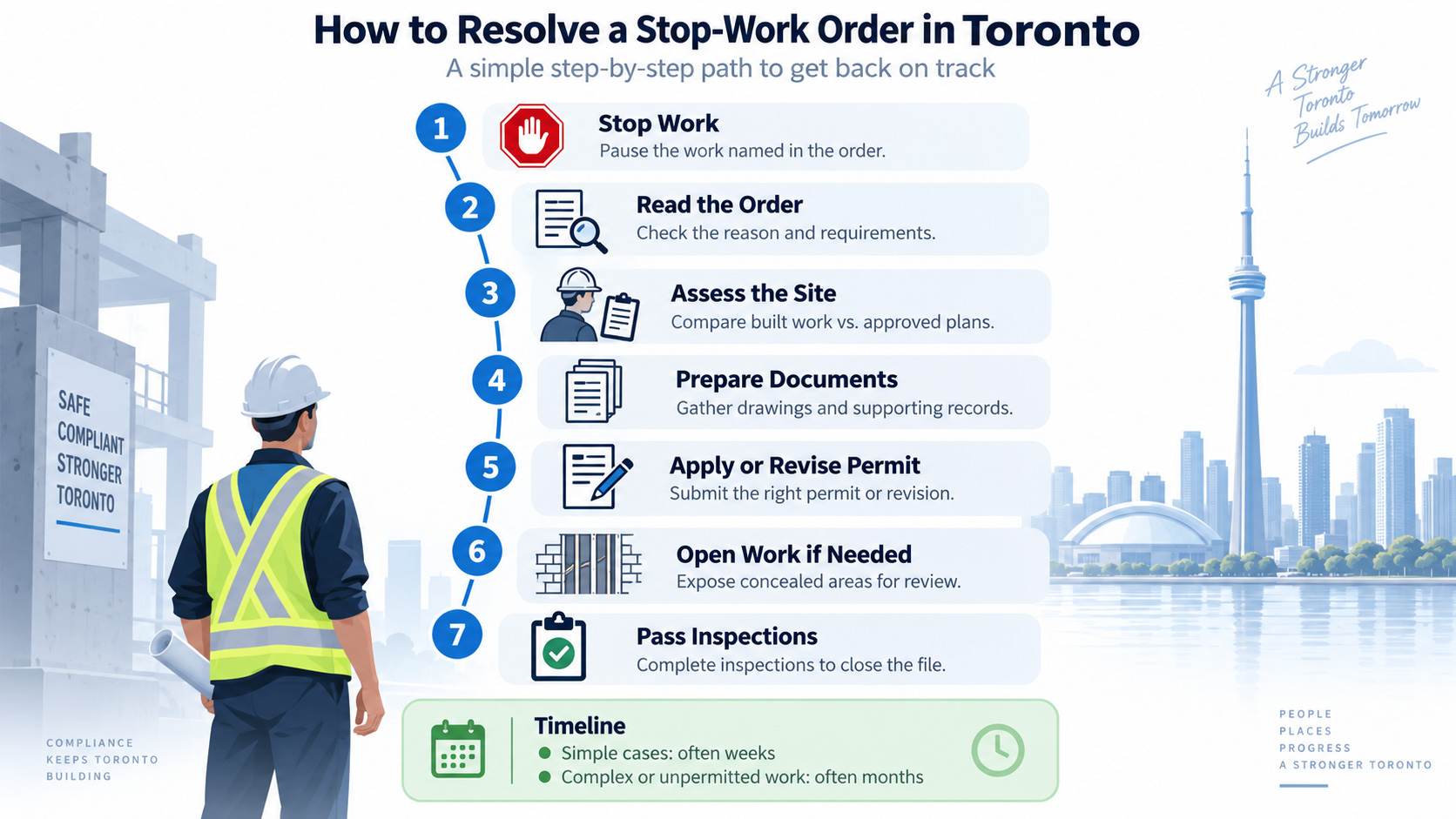
1. Stop the specific work named in the order, and only that work. Don’t guess at scope. If you’re unsure whether something is covered, treat it as covered until confirmed otherwise.
2. Read the order line by line, not just the headline. It should reference the specific contravention, cite the relevant section, and name the officer who issued it. That officer’s contact information is your fastest path to clarity: call them before you do anything else.
3. Get an honest assessment of what’s actually built versus what was approved (or never applied for). This is the step people try to skip, and it’s the one that determines everything downstream. If you’re not confident reading permit drawings and comparing them to site conditions, this is where a permit expediter or designer earns their fee.
4. Prepare the documentation Toronto Building will actually ask for, including as-built drawings showing current conditions, proposed drawings if changes are needed, and copies of any existing permits tied to the property.
5. Apply for the correct permit or permit revision. Depending on the situation this might be a brand-new application, a revision to an existing permit, or in some cases a combined application covering multiple deficiencies at once.
6. Expect to open some of it back up. If work was closed in before an inspection happened, don’t be surprised if the inspector asks to see behind drywall or under flooring. This is routine, not punitive. It’s the only way to verify what’s actually there.
7. Book and pass the required inspections. This is what actually closes the file. An approved permit application without a signed-off final inspection is not a resolved order; it’s a resolved application with an open compliance file still attached to it.
You Do Have the Right to Appeal
Most content on this topic skips this entirely, but it’s a real part of the process. Under the BCA:
- Section 25 lets you appeal an order to the Superior Court of Justice.
- Section 24 allows an appeal specifically to the Building Code Commission, but only on the question of whether the technical requirements of the Building Code have actually been met, not a general dispute of the order.
These routes exist for genuine disagreements about interpretation or technical sufficiency, not as a delay tactic. If you believe the order was issued in error (the wrong section cited, a misread of what’s actually on the drawings), this is the formal channel, and it’s worth a conversation with someone who’s dealt with the Building Code Commission before you file anything yourself.
How Long Does This Actually Take?
There’s no fixed timeline, and anyone who quotes you one without seeing your specific order is guessing. What actually drives the clock:
- Whether you’re dealing with a straightforward documentation gap or genuine construction that needs to be partly undone
- How quickly a designer or professional can produce compliant drawings
- Toronto Building’s current permit review queue (this moves; check current processing times rather than relying on a number from last year)
- Whether the inspector needs to see concealed work opened up before signing off
- Whether the file involves a permit revision (usually faster) or a fresh application for unpermitted work (usually slower)
A documentation mismatch with otherwise sound construction can sometimes clear in a matter of weeks. A basement apartment built without any permit, inspections, or drawings is a different scale of project, often months, not weeks, once you factor in design, application review, and the inspections themselves.
Do You Need to Hire Someone?
Not always. If the issue is minor and well-documented, some owners handle it directly with Toronto Building. Where people tend to bring in a permit professional is when:
- The order involves work that’s already built (as-built drawings need to be produced, not just design drawings)
- There’s a permit revision required on top of the original scope
- Zoning is tangled up with the building issue, which additions and garden suites in particular often trigger at the same time
- You’re dealing with a Building Code Commission appeal or a technical compliance dispute
The honest answer is that the complexity of your file, not the fact that you got an order at all, should decide this.
Frequently Asked Questions
Can I sell my house with an open Stop-Work Order or unresolved permit? Technically the property can still change hands, but most buyers’ lawyers will flag an open order or unclosed permit during due diligence, and it can hold up or reduce the sale. Resolving it before listing is almost always cheaper than negotiating it away in a purchase agreement.
What if the unpermitted work was done by a previous owner? It’s still your responsibility to resolve now that you own the property; see the section above. Ownership history doesn’t change the compliance obligation.
Will Toronto Building make me tear out finished work? Sometimes, but not automatically. If the work can be verified as safe and code-compliant through inspection (including opening up concealed areas), it’s often legalized in place. Removal is typically reserved for work that genuinely can’t be verified or brought into compliance without it.
Is there a way to speed this up? Complete, accurate documentation submitted the first time is the single biggest lever. Incomplete applications that bounce back for corrections are the most common cause of delay, more so than the city’s processing queue itself.
Where This Leaves You
A Stop-Work Order feels like a crisis on the day it’s posted. In practice, it’s a process with a defined path through it: identify the specific violation, document the current condition accurately, apply for the right permit or revision, and get the inspections that actually close the file. The order isn’t personal, and for almost everyone who follows the process instead of fighting it, it ends with the project moving forward again.
If you’re staring at drawings that don’t match what’s on site, or you’re not sure whether what you’re looking at is an Order to Comply or a true Stop-Work Order, iPermit works through exactly this process with Toronto property owners, from assessing the current condition, through drawings and permit revisions, to closing out the file with Toronto Building. You can read more about what happens when renovations are done without a permit in Toronto, and where zoning gets tangled up with a building order, iPermit’s zoning review and rezoning services cover that side of it too.